
Planning a trip to France? There are some incredible landmarks to see—from iconic Paris monuments to medieval castles, Roman ruins, historic cathedrals, and beautiful natural landscapes.
I’ve visited France nearly a dozen times, and it’s still one of my favorite countries to explore. While many of France’s most famous landmarks are in Paris, some of my favorite discoveries have been outside the capital.
I’ve rounded up 25 of the best and most famous landmarks in France, including some you probably recognize and a few that might inspire you to venture beyond the usual tourist trail.
Disclaimer: This page may contain affiliate links. I earn a small commission if you make a purchase through these links (at no additional cost to you). See our Privacy Policy and our Disclaimer for more information.
1. Eiffel Tower
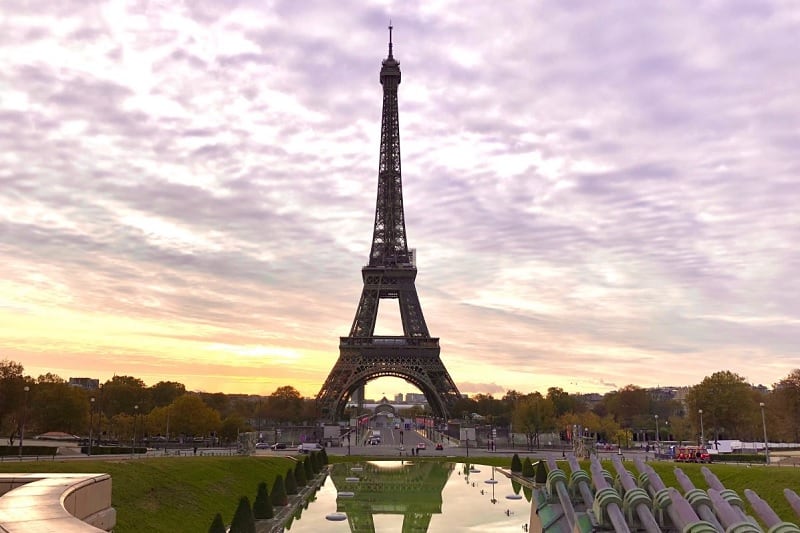
The Eiffel Tower is the most recognizable landmark in France. Some people love it, some people hate it. Me—I love it, and I visit it every time I’m in Paris.
Constructed by Gustave Eiffel for the 1889 Exposition Universelle, the tower was initially met with resistance from artists who called it an eyesore.
It was also intended to be a temporary structure, which is a mind-boggling fact about France. Happily, they decided to keep it!
Standing at over 1000 feet, the Eiffel Tower was the world’s tallest man-made structure until the Chrysler Building in New York City was completed in 1930.
The first floor has restaurants and a glass floor, while the second floor has shops and exhibits about the Eiffel Tower. (I climbed the stairs to the second floor on my first visit to Paris!)
If you want to go all the way to the top, take the elevator to the summit for panoramic views of Paris.
And of course, be sure to watch the Eiffel Tower’s nightly lights show. At the top of the hour after dusk, the Tower sparkles with dancing lights. It’s one of the romantic things about Paris!
Tip: My favorite place to take photos of the Eiffel Tower is from the Trocadéro, just across the river. It’s a popular spot—and a popular Paris film location—so get there early if you want a good photo.
2. Louvre Museum

As you approach the grandeur of the Louvre Museum, the iconic glass pyramid (by I.M. Pei) at the museum’s entrance commands your attention.
Nestled in the heart of Paris, the Louvre is not just a museum; it’s a historic palace adorned with a vast collection of art that spans several millennia and geographic regions.
It doesn’t surprise me that the Louvre is the most popular museum in France — and in the world!
The Louvre’s collection boasts nearly a half-million objects of art. Some of the most famous pieces are the Mona Lisa, the Venus de Milo, and The Raft of the Medusa.
From The Winged Victory of Samothrace casting an imposing silhouette, to the delicate brush strokes of the Mona Lisa’s enigmatic smile, each piece beckons you closer.
(And if you love classical statues like I do, be sure to visit La Salle des Cariatides.)
To fully appreciate this cultural jewel, carve out ample time in your schedule and wear comfortable shoes — you’re going to be doing a lot of walking!
Tip: the museum is closed on Tuesdays.
Avoid the lines and buy your Louvre guided tour tickets in advance!
3. Notre-Dame Cathedral

Notre-Dame de Paris is one of France’s most iconic landmarks, and after the devastating 2019 fire, it reopened to visitors in December 2024 following five years of restoration. The cathedral is once again welcoming visitors on the Île de la Cité, although restoration work continues on parts of the exterior.
I fell in love with Notre-Dame on my very first visit to Paris. It was a solo trip, and I eagerly bought my Paris Museum Pass and toured this amazing cathedral. And yes, I climbed the 387 steps to the top of the towers! The view of Paris from up there was incredible, and I loved getting an up-close look at the whimsical carved figures on the rooftop.
The interior is just as impressive, with its soaring Gothic architecture, stained glass, chapels, and artwork. The cathedral is free to visit, although the official website recommends reserving a free time slot to help avoid a long wait.
Good to know: If you want to climb the towers, that’s a separate experience from visiting the cathedral and requires its own reservation.
4. Sainte-Chapelle

Photo Credit: Find Love and Travel
Sainte-Chapelle is one of the most beautiful Gothic churches in Paris—and the stained glass is the reason to go. Built in the 13th century on the Île de la Cité, this former royal chapel was designed to house important Christian relics, including what was believed to be the Crown of Thorns.
The highlight is the upper chapel, where enormous stained-glass windows fill the room with color. There are more than 1,000 individual scenes depicted in the windows, telling biblical stories from the Old and New Testaments. When the sunlight comes through the glass, the effect is pretty spectacular.
I first visited Sainte-Chapelle when the windows were undergoing restoration, so I didn’t get to see the chapel in its full glory. Even with some of the stained glass covered, I still thought it was worth visiting. I’d definitely recommend adding it to your Paris itinerary if you enjoy architecture, history, or beautiful interiors.
Tip: It’s by far best to visit Sainte-Chapelle on a sunny day. If it’s raining, visit one of the many excellent museums in Paris instead.
5. Arc de Triomphe

As you stroll along the Champs-Élysées, the majestic Arc de Triomphe commands your attention.
Commissioned by Napoleon in 1806, this monument is a symbol of French pride, standing tall at the western end of the famous avenue. It celebrates the victories of the French army and honors those who fought and died for France.
Climbing the 284 steps to the top, you are rewarded with panoramic views of Paris that take your breath away. (Tip: It’s a great vantage point for viewing the Eiffel Tower!)
The intricate sculptures adorning the pillars of the arch tell stories of battles and triumphs, a testament to its rich historical significance.
Underneath the Arc lies the Tomb of the Unknown Soldier, with its eternal flame that burns in memory of the fallen soldiers who were never identified from World War I.
Each evening, you can witness the mesmerizing ceremony of rekindling the flame—a moment steeped in reverence and history.
The Arc de Triomphe takes center stage during Bastille Day, the most important holiday in France.
6. Sacré-Cœur Basilica

When you visit the vibrant city of Paris, the Sacré-Cœur Basilica is a stunning monument you won’t want to miss.
Perched majestically atop Montmartre, the highest point in the city, it offers you panoramic views that are truly breathtaking. The basilica’s ivory domes rise into the sky, with their unmistakable Romanesque-Byzantine flair.
Take a few quiet moments to explore the basilica’s serene interiors. Admire the opulent gilded mosaics and beautiful works of art.
You’ll have to conquer a lot of steps to fully explore the beauty of Sacré-Cœur. There are over 200 steps up the hill, and another 300 steps if you want to climb the dome! We did that on one of our first trips to Paris.
While it’s free to enter the basilica, there is a fee to enter the crypt or the dome.
Fun fact: Sacré-Cœur holds the record for the largest bell in France. The Savoyarde weighs in at a whopping 19 tons!
7. The Pantheon

Nestled in the heart of Paris’s Latin Quarter, the Pantheon stands as a monument to French history and architecture.
Originally constructed as a church dedicated to St. Genevieve, you’ll find its purpose has evolved over the years to become a mausoleum housing the remains of distinguished French citizens.
The inscription above the entrance reads ‘AUX GRANDS HOMMES LA PATRIE RECONNAISSANTE,’ meaning ‘To the great men, the grateful homeland.’
The facade is inspired by the Pantheon in Rome, so it should come as no surprise that the Pantheon in Paris would look perfectly at home in Italy.
As you step inside, admire the grand interior and the intricate artwork. The dome is a marvel, engineered with an impressive triple shell design. For some fabulous views of Paris, climb to the top of the dome!
The Pantheon is home to the famous Foucault’s Pendulum, which was the first demonstration of the Earth’s rotation. (The nerdy engineer in me loves things like this!)
8. Les Invalides

In the heart of Paris, you’ll find Les Invalides, a remarkable historical site that demands your attention.
Its official name, Hôtel National des Invalides, doesn’t quite do justice to its grandeur.
This complex of buildings was initially designed as a hospital and retirement home for war veterans by King Louis XIV. Today, it stands as a symbol of French military history.
The most eye-catching part of Les Invalides is its striking golden dome. This is the tomb of Napoleon Bonaparte. (We discovered on our last trip to Paris, that the best views of the dome are from behind Les Invalides!)
The Musée de l’Armée houses one of the largest military history and art collections in the world. Here you’ll find an extensive array of weapons, armor, and uniforms.
Chris is a big military history buff and loved the miniature replicas of fortresses.
Wander through the Cathedral of Saint-Louis des Invalides and admire its elegant interior.
Each corner of this complex lets you step into a different page of French history, making Les Invalides a must-see for anyone fascinated by military history.
9. Normandy Beaches

The Normandy Beaches are a poignant reminder of World War II.
They invite you to walk along the same shores where the Allied forces made their legendary D-Day landings on June 6, 1944.
Omaha Beach was the site of crucial D-Day operations, with Utah Beach serving as an additional landing beach for the Allies.
A visit to the American Cemetery is a humbling and sobering experience as you gaze upon rows of white crosses that stretch into the horizon. This site honors the bravery of the soldiers who fought for freedom.
With its immaculate grounds and overlooking view of Omaha Beach, it’s a place for reflection and appreciation.
Omaha and Utah beaches offer museums and memorials. You can enrich your knowledge of the historical events and heroic stories of that fateful day.
Whether you’re a history buff, in search of some contemplation, or simply looking to explore remarkable sites, the Normandy Beaches open a chapter of history right before your eyes.
On our first big trip to France, we took a tour of the Normandy Beaches and the American Cemetery.
Our local guide shared touching stories from her family’s experiences during the war, and how much gratitude they feel to this day to their liberators. These shared stories are a special experience that you just can’t get from a book but must be experienced in person.
Check out these top tours of the Normandy beaches:
10. Notre-Dame de Fourvière Basilica
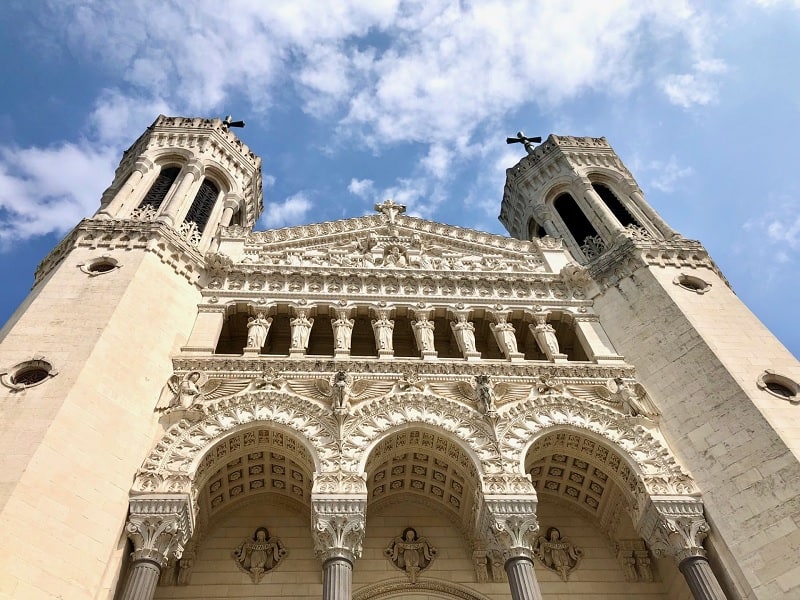
Perched atop the Fourvière hill, Notre-Dame de Fourvière Basilica stands as a grand symbol of Lyon’s religious heritage. It’s one of the most beautiful basilicas in Europe.
This stunning basilica, fondly nicknamed the “upside-down elephant” by locals, offers breathtaking panoramic views of the city. It’s certainly one of the top attractions in Lyon!
The easiest way to get to the top of Fourvière hill to visit the basilica is by taking the funicular.
As you approach the basilica, the intricate facade with its four towers captures your attention, as does the golden statue of the Madonna glinting in the sun.
On stepping inside, the interior welcomes you with vibrant stained-glass windows and expansive gilded mosaics of religious scenes.
After seeing the marvelous basilica, be sure to take in the panoramic views over Vieux Lyon. This is definitely one of the best photo spots in Lyon!
Make your visit to Lyon complete with a trip to Notre-Dame de Fourvière Basilica; it’s an experience that beautifully blends awe-inspiring views with stunning architecture.
11. Chartres Cathedral

Chartres Cathedral is one of France’s great Gothic masterpieces—and its stained glass is the real showstopper. The Cathedral of Our Lady of Chartres is a UNESCO World Heritage Site, recognized for its remarkable Gothic architecture, sculptures, and collection of medieval stained-glass windows.
One of the things that makes Chartres so interesting is its two very different spires. The simpler Romanesque spire dates to the 12th century, while the more elaborate Flamboyant Gothic spire was added in the 16th century. Together, they give you a visual reminder of how the cathedral evolved over the centuries.
Inside, look for the labyrinth set into the floor of the nave. It was designed as a path for meditation and reflection, and it’s one of the cathedral’s most distinctive features.
But it’s the stained glass that really makes Chartres special. The cathedral has an extraordinary collection of medieval windows, with more than 2,000 individual figures depicted across hundreds of panels. If you visit on a sunny day, the light coming through the glass fills the nave with beautiful colors.
Take some time to look closely at the windows—they aren’t just decorative. Many tell biblical stories and would have helped communicate those stories to people who couldn’t read.
Good to know: Chartres is an easy day trip from Paris, making it a great option if you want to see more of France beyond the capital.
Take this private tour to Chartres from Paris if you’d like to visit the cathedral with a guide and make the most of your time there.
12. Reims Cathedral

When you step into Reims Cathedral, you’re walking through one of the major historical landmarks of France.
Imagine gazing at the same kaleidoscope of stained-glass windows that have been enchanting visitors since the 13th century.
The cathedral’s façade, adorned with intricate sculptures, tells tales of kings and queens from a time long past.
The cathedral is historically significant for its role in the coronation of French monarchs. Your visit here connects you to the echoes of royal fanfares, with over 25 kings crowned within these walls.
The grandeur of the cathedral is not just in its towering spires or the Rose window’s captivating design; it’s in the details.
Look for the smiling angel statue, a symbol of Reims, which has charmed visitors for centuries with its serene and welcoming expression. She is also charmingly known as ‘the smile of Reims’.
It’s easy to see why the Cathedral of Notre-Dame of Reims is one of the most important monuments in the history of France!
13. Palace of Versailles

When you step into the Palace of Versailles, you enter a world where royal history and opulent artistry meet. This UNESCO World Heritage site is a must-see French landmark with easy access from Paris.
Once the epicenter of French power, Versailles boasts stunning gardens, the glittering Hall of Mirrors (with 357 mirrors!), incredible works of art, and lavishly decorated state rooms.
Immerse yourself in the luxury that surrounded Louis XIV, the Sun King, whose reign exemplifies the height of French monarchy’s prestige.
View the majestic Royal Chapel, a symbol of the palace’s splendor. Visit the Trianon and the Queen’s hamlet, the refuge of Marie Antoinette.
Versailles is one of France’s most magnificent attractions, and it’s easy to picture courtiers in their finery walking through its esteemed halls.
My favorite part is the exquisite gardens of Versailles. Discover classical statues and impressive fountains as you wander through the trees and shrubbery manicured with incredible, artistic precision.
While you do need tickets to enter the Palace, the fabulous Versailles gardens are free to visit (except on days of the musical fountains shows).
Here are some great ways to visit the Palace of Versailles:
14. Château de Chambord

The Château de Chambord in France’s Loire Valley is a castle straight out of the pages of a fairy tale.
This architectural masterpiece is a captivating blend of traditional French medieval forms with classical Italian structure.
It’s the largest château in the Loire Valley, erected during the Renaissance period, under the instruction of King Francis I.
Explore the vast estate of the château, spread over 5,440 hectares. Marvel at the iconic skyline with its distinctive white turrets and towers.
And the castle’s famed double helix staircase is simply stunning! Attributed to Leonardo da Vinci, marvel at the two spirals that ascend the château without ever meeting.
Imagine wandering through over 400 rooms, exploring the opulent royal chambers, and admiring the French Renaissance artworks that grace the walls.
The Château de Chambord is truly one of the most beautiful places to see in France!
See two of the most beautiful châteaux in France on these amazing day trips:
15. Château de Chenonceau

Nestled in the heart of the Loire Valley, the Château de Chenonceau stands as a breathtaking testament to Renaissance architecture. As you wander through its ornate rooms, imagine the historical figures who once graced these very halls.
The château is also known as the “Ladies’ Castle,” having been built, enhanced, and protected by influential women throughout its history. Most important were Diane de Poitiers and Catherine de’ Medici.
One of the most striking aspects of the castle’s architecture is the elegant arched gallery stretching over the Cher River. This gallery with its eye-catching black-and-white tiled floor once dazzled with 16th-century balls.
Take a stroll through the picturesque gardens of Chenonceau. Diane de Poitiers’ Garden on the east boasts a formal layout of flowers and clipped hedgerows, while Catherine de’ Medici’s Garden on the west offers a more subdued elegance.
The mesmerizing Château de Chenonceau invites you to step back in time and experience a slice of French history first-hand.
For an unforgettable experience, take a hot-air balloon ride in the Loire Valley — it’s an incredible way to see the Château! (We did this, and it was truly amazing!)
16. Palais des Papes
Nestled in the heart of Avignon, the Palais des Papes embodies a unique chapter in religious history.
Not many people know it, but Avignon (not Rome) was the seat of the Papacy in the 14th century. Today you can tour the expansive halls where the popes once resided (it’s one of the best things to do in Avignon).
Its facade, an imposing example of Gothic architecture, dazzles with its grandeur, inviting you to discover the secrets held within.
As you meander through the 14th-century palace, you’ll encounter the beauty of the private chambers, adorned with exquisite frescoes.
The palatial grounds and courtyards reveal the day-to-day activities of a bygone era, allowing you to step back in time and visualize the splendor of papal ceremonies.
And don’t miss the panoramic views of Avignon from the terrace, where you can admire the scenic Rhône River and the medieval Pont d’Avignon.
17. Pont d’Avignon

The Pont d’Avignon is one of those French landmarks that looks a little different from what you might expect. Officially known as the Pont Saint-Bénézet, this medieval bridge once stretched across the Rhône—but today, only four of its original arches remain.
The bridge was originally built in the 12th century and eventually extended to 22 arches, spanning much of the Rhône. Over time, repeated flooding and other damage destroyed much of the bridge, leaving the four arches you see today. The Pont Saint-Bénézet is part of the Historic Centre of Avignon UNESCO World Heritage Site, along with the Palais des Papes.
You can walk onto the remaining section of the bridge and visit the small Chapel of Saint Nicholas, which sits on the second pier. I think seeing the bridge up close makes its history much easier to appreciate than simply looking at it from the riverbank.
And yes, this is that bridge—the one from the famous French song “Sur le Pont d’Avignon.”
Tip: Don’t just look at the bridge from the city side. Some of the best views are from across the Rhône, where you can see the Pont d’Avignon and the Palais des Papes together. You can cross the river on the free ferry, which makes it easy to get a different perspective and some great photos.
18. Mont Saint-Michel

Mont-Saint-Michel is one of the most spectacular sights in northern France — and I’ve finally visited it!
Located off the coast of Normandy, Mont-Saint-Michel is a medieval island village crowned by an impressive Gothic abbey. The combination of the abbey, stone fortifications, and narrow cobbled streets makes this one of those French landmarks that really does look almost unreal when you first see it.
The Abbey of Mont-Saint-Michel sits at the highest point of the island and is the main attraction. It’s a remarkable example of medieval architecture, and I definitely recommend going inside rather than simply admiring it from the outside. You’ll need a ticket and a reserved time slot to visit the abbey.
Once you’re inside the village, take some time to wander beyond the main street. The narrow lanes, old stone buildings, shops, and restaurants are part of what makes Mont-Saint-Michel so memorable. And don’t forget to look back toward the bay as you climb—the views are a big part of the experience.
The tides are another reason Mont-Saint-Michel is so fascinating. The surrounding bay has some of the largest tidal variations in Europe, and the landscape can look dramatically different depending on the tide. At high tide, the Mont can appear to rise almost completely surrounded by water, creating that iconic view you’ve probably seen in photographs.
If you’re visiting from Paris, Mont-Saint-Michel makes a memorable day trip, although it’s a long day. Check out this Mont Saint Michel tour from Paris!
19. Carcassonne
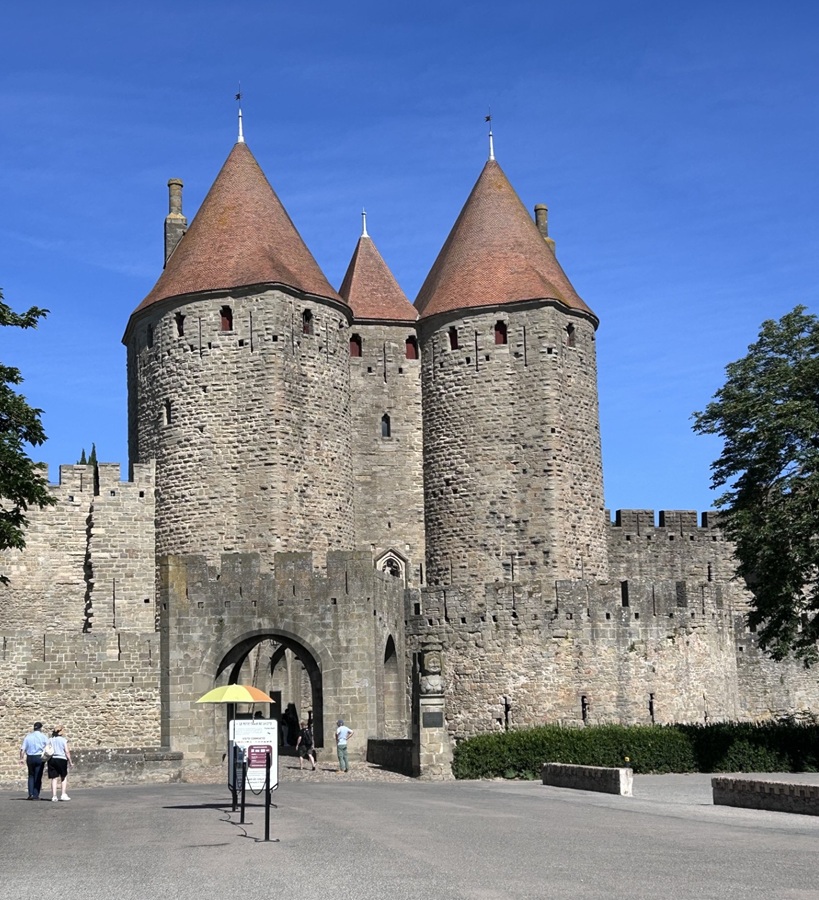
Carcassonne is one of the most impressive medieval walled cities I’ve visited in France. Located in southern France, the Cité de Carcassonne is surrounded by massive fortifications and towers that make it easy to see why this UNESCO World Heritage Site is such a popular destination.
Inside the walls, you’ll find narrow streets, shops, restaurants, the beautiful Basilica of Saint-Nazaire, and the Château Comtal (Count’s Castle). You can also walk along portions of the fortifications for a closer look at the towers and surrounding countryside.
I finally visited Carcassonne, and it really is wonderful. What I especially enjoyed was hearing the stories behind the city’s history. Our tour guide told us one of the legends associated with the siege of Carcassonne—and it’s one of those stories that makes a historic place come alive.
According to the legend, the people of Carcassonne were running out of food during a siege and were down to their last pig. Lady Carcas supposedly came up with a clever plan: she had the townspeople feed their remaining grain to the pig and then throw the well-fed pig over the city walls.
The attackers saw the pig and apparently thought, “If they have enough food to throw out a pig, we’re going to be here forever.” So they abandoned the siege.
Whether or not the story is historically accurate, I loved hearing it. It’s a perfect example of how the legends surrounding Carcassonne add another layer to exploring the medieval city.
Be sure to allow time to wander the Cité rather than simply visiting the major sights. The fortifications, gates, towers, and winding streets are a big part of what makes Carcassonne so memorable.
20. Arena of Nîmes

When you step into the Arena of Nîmes, you’re walking into one of the best-preserved Roman amphitheaters in the world. It’s definitely one of the must-see attractions in Nimes!
Imagine gladiators battling for glory in the same spot over two millennia ago. This historic monument dates from the 1st century AD and could once seat an impressive 24,000 spectators.
The amphitheater is remarkably well preserved, a testament to the architectural prowess of the ancient Romans. (How many modern buildings are going to be usable in 2 millennia?)
Spanning 133 meters in length and 101 meters wide, it’s an architectural marvel that has stood the test of time.
Admire the intricate details of the arches and the stonework that tell stories of a bygone era. While you tour the arena, the audioguide transports you back to Roman times as well.
The spectacular Arènes de Nîmes is still used today. It hosts concerts, sporting events, and even bullfights, connecting the present to a rich historical tapestry. And it’s the centerpiece of one of the city’s most popular festivals, the Feria de Nîmes.
I loved my visit to Nîmes last summer! It’s definitely worth taking the tour of the arena, and the audioguide is very good. It really brings the past to life.
In addition to the Roman arena, be sure to visit the stunning Maison Carrée, a classical temple that was just named a UNESCO World Heritage site. Climb the Tour Magne for amazing views of Nîmes and the French countryside.
See the Arena of Nîmes and the Pont du Gard on this day trip from Avignon!
21. Pont du Gard

The Pont du Gard is one of the most impressive Roman structures in France. This enormous three-tiered aqueduct was built in the 1st century AD to carry water to the Roman city of Nîmes, and it has survived remarkably well for nearly 2,000 years.
The scale is what really gets you when you see it in person. The aqueduct rises high above the Gardon River, and you can walk along the riverbanks for different views of the structure. It’s also possible to walk across the lower level of the aqueduct, giving you a closer look at the massive stone construction.
The Pont du Gard isn’t just a place to stop for a quick photo, either. The surrounding site is beautiful, with walking paths, picnic areas, and access to the river. In warmer weather, you can even swim in designated areas of the Gardon.
There’s also a museum and visitor center where you can learn more about the construction of the aqueduct and the engineering behind it. As an engineer, I find Roman engineering like this especially fascinating. It’s pretty amazing to think about the planning and precision that went into building a structure of this scale almost 2,000 years ago.
If you’re visiting Nîmes or Avignon, the Pont du Gard makes a worthwhile side trip. Allow at least a couple of hours to see the aqueduct and explore the surrounding area rather than simply pulling over for a photograph.
Good to know: The site is large, so wear comfortable shoes and allow some time to walk around. If you’re visiting in summer, go early or later in the day to avoid the strongest heat.
22. Millau Viaduct

Photo Credit: Discover Spain Today
The Millau Viaduct is one of the most remarkable examples of modern engineering in France. Spanning the Tarn Valley in southern France, this enormous cable-stayed bridge carries the A75 motorway high above the valley floor.
Opened in 2004, the viaduct was designed by French engineer Michel Virlogeux and architect Norman Foster. Its slender profile and seven soaring piers make it look surprisingly light for a structure of this size.
You can see the Millau Viaduct from several viewpoints around the valley, and the perspective from below really gives you a sense of just how enormous it is. If you’re driving through this part of southern France, it’s worth planning a stop rather than simply crossing the bridge and continuing on.
The nearby town of Millau is also a good place to stop for views and to learn more about the viaduct. The Viaduc de Millau visitor area has information about the bridge and its construction, and there are viewpoints where you can appreciate the scale of the structure and the surrounding landscape.
23. Promenade des Anglais

Nestled along the Mediterranean coastline is Nice’s treasured Promenade des Anglais, an iconic beachfront boulevard. It’s one of the best reasons to visit Nice!
Imagine feeling the gentle sea breeze and soaking in the southern French sun as you meander along the expansive walkway which stretches 7 kilometers along the beautiful beaches of Nice.
You’ll find joggers, skaters, and cyclists enjoying the fresh air alongside tourists captivated by the scenery. And why not? Walking along the Promenade des Anglais is certainly one of the top things to do in Nice!
With the Baie des Anges’ azure waters on one side and a picturesque row of majestic palm trees bordering historical Belle Époque buildings on the other, the promenade is a feast for your eyes.
Pause to admire the iconic Hotel Negresco, a testament to luxurious architecture and history since 1912. (And maybe stop here to sip a cocktail!)
This landmark is not just a walkway; it’s the lifeblood of Nice, bursting with cultural festivals, markets, and open-air performances. Nice’s famed Carnival celebrations feature parades that wend along the Promenade des Anglais — truly a site to behold!
(Want to explore more of the French Riviera? It’s easy to take a Nice to Monaco day trip!)
24. The Calanques

The Calanques National Park is one of the most dramatic coastal landscapes in southern France. Located between Marseille and Cassis, the park is known for its steep limestone cliffs, turquoise Mediterranean water, and narrow inlets called calanques.
I’ve seen the Calanques from above as well as from a boat, and I think seeing them from the water is a particularly memorable way to appreciate the landscape. From the boat, you get a completely different perspective of the towering limestone cliffs and the little coves tucked along the coastline.
You can also explore the Calanques on foot, although this isn’t necessarily an easy hike. Some trails are steep and rocky, and access to certain areas can be restricted during periods of high fire danger. If you’d rather enjoy the scenery without a strenuous hike, a boat tour from Marseille or Cassis is a great alternative.
The Calanques are especially popular in summer, but that’s also when heat, crowds, and access restrictions can make visiting more challenging. Spring and early fall can be excellent times to explore, particularly if hiking is part of your plan.
If you’re visiting Marseille, you can access several of the calanques from the city. Cassis is another popular base and is especially convenient if you’d like to see the coastline by boat. (I took a boat tour from Marseille — it took a little time to get out there, but it was worth it.)
Good to know: Check current trail access and fire restrictions before heading out, particularly during the summer months. If you’re hiking, bring plenty of water and wear sturdy shoes. And if you don’t want to tackle the trails, don’t feel like you’re missing out—the view from the water is pretty spectacular too.
Experience the beauty of the Calanques on one of these tours:
25. Lavender Fields

Photo Credit: Scotland Less Explored
Provence’s lavender fields are one of those French landscapes that really do live up to the photographs. When the lavender is in bloom, the fields turn shades of purple and fill the countryside with their distinctive fragrance.
The best time to see the lavender in bloom is typically from June into August, although the exact timing varies depending on the location, weather, and variety of lavender. If seeing the fields is a priority for your trip, it’s worth checking current bloom conditions before you go.
Some of the most famous lavender-growing areas are around Valensole, where you’ll find expansive fields that make for spectacular photos. Other areas of Provence, including the Luberon and around Sault, also have lavender fields worth exploring.
One thing to keep in mind: the lavender fields are spread throughout the countryside rather than concentrated at a single attraction. You’ll get the most out of a visit if you have a car or take a guided tour, especially if you’re hoping to see several fields in one day.
And don’t just admire the lavender from the roadside. Stop to walk around, take in the fragrance, and enjoy the scenery. Just be respectful of the fields—many are privately owned, so stick to designated paths and don’t pick the lavender unless you’re specifically allowed to do so.
France Landmarks Map
Wondering where all these top French landmarks are located? Here’s a map of the most famous landmarks in France to help you to get oriented.
Final Thoughts:
France has no shortage of famous landmarks, but you don’t have to limit yourself to the Eiffel Tower and the Louvre. Some of my favorite experiences have come from getting outside Paris and exploring places like the Normandy beaches, the Loire Valley châteaux, Roman sites in southern France, and of course, Lyon.
My advice? Pick a few of the iconic sights you’ve always dreamed of seeing, but leave room for a few unexpected discoveries, too. France is a country where history is everywhere you look.
If you’re planning your first trip to France, my guide to the best things to do in Lyon is a good place to start if Lyon is on your itinerary. And if you’re heading to Paris, you’ll find plenty of ideas in my guide to the top things to do in Paris.
Want to explore beyond the major landmarks? My guides to the best museums in France and French breakfast pastries will help you experience a little more of the culture that makes France such a wonderful destination.
Planning a trip to France? You’ll certainly want to visit these famous sites in France. Pin this for later!


Lisa Garrett
Lisa Garrett is a professional travel advisor and the founder of Travel to Lyon and Waves and Cobblestones.
She has explored Lyon with her husband, Chris, as well as on solo trips to France. She has visited Lyon many times, including a two-week stay last spring (unseasonably cold for a Phoenix girl!). Whether you’re interested in food, history, or culture, Lisa’s firsthand experience and practical tips will help you plan your perfect trip to Lyon.
Learn more about Lisa!
